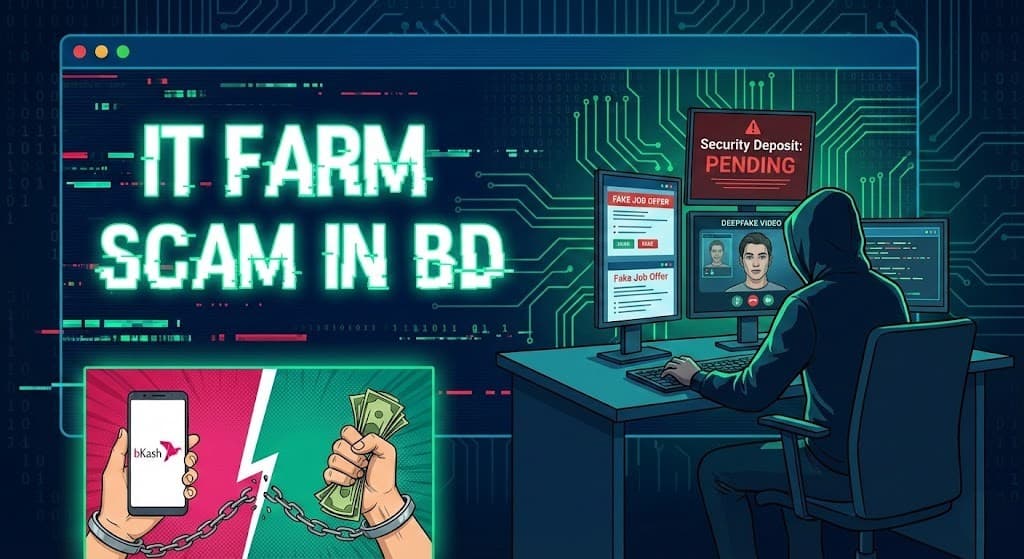

In Bangladesh, most IT scams follow a "Hybrid Fraud" model. They often present themselves as outsourcing firms, software houses, or training institute
The "Security Deposit" Trap
The most common scam involves a fake job offer. After a mock interview, the candidate is told they are hired but must pay a "security deposit" for equipment (laptops/software) or as a "commitment fee."
- The Reality: Once the money is paid via MFS (Mobile Financial Services) like bKash or Nagad, the company vanishes or provides "training" that consists of watching basic YouTube videos.
The "Prepaid Task" Scam (Gamified Task Fraud)
As of late 2025, a more complex model has emerged. Scammers add victims to Telegram groups and ask them to perform simple tasks—like giving Google Reviews or testing a website's UI—for a small payment (e.g., 200–500 BDT).
The Hook: After winning your trust with small payments, they invite you to a "VIP Task" that requires a "Prepaid Investment" to unlock a larger commission.
The Blow: Once you invest a significant amount (e.g., 50,000 BDT), your account is "frozen" due to a "system error," and they demand more money to "unblock" it.
2. The 2025-2026 Evolution: AI & Deepfakes
Technology has given scammers new weapons. In early 2026, reports from the CID (Criminal Investigation Department) highlighted that fraud rings are now using:
AI-Generated CEOs: Using deepfake technology, scammers conduct video interviews on platforms like Telegram or WhatsApp, impersonating high-level executives to build instant credibility.
Automated "Ghost" Websites: These are high-quality, professional-looking portfolio sites that exist only for a few months. They often clone the UI of famous international firms (like "Microsoft" vs "https://www.google.com/search?q=Micro-soft-bd.com").
The Shadow Crypto Market: While cryptocurrency is in a legal gray zone in Bangladesh, many fake IT farms now demand "processing fees" in USDT to avoid the paper trail of local bank accounts.
3. Real-World Cases: 2025 Highlights
| Case Name | Location | Scam Method |
| MS IT Institute | Bogura | Collected millions in "security deposits" from hundreds of local youths under the guise of employment. |
| BCJ (Bangladesh-China-Japan) | Uttara, Dhaka | Targeted retired officials with fake "Director" roles and high-profit import-export IT projects. |
| SikkahBot Campaign | Online/MFS | Used malware to target students' MFS accounts while promising "free freelancing tools." |
4. Red Flags: The "IT Farm" Checklist
If you encounter a company with these traits, tread carefully:
Generic Domains: Emails coming from
@gmail.comor@outlook.comrather than a corporate domain (e.g.,@companyname.com).Urgent Hiring: They offer the job almost immediately without a technical evaluation (coding test or system design round).
MFS-Only Payments: If they insist on receiving "registration fees" or "document fees" via bKash/Nagad personal numbers instead of a corporate bank account.
No Physical Presence: They claim to have an office in Banani or Dhanmondi, but "visitors are not allowed due to security."
High Pay, Low Skill: Offering 60,000 BDT for a "Data Entry" or "Social Media Liker" role that requires no prior experience.
5. How to Protect Yourself
Verify Trade License: Ask for the company’s BIN (Business Identification Number) and Trade License. Legitimate IT firms are usually members of BASIS (Bangladesh Association of Software and Information Services).
LinkedIn Audit: Search for the company on LinkedIn. If a "50-employee company" only has 2 profiles with no history, it’s a ghost entity.
Physical Verification: Never pay money before visiting the physical office and speaking to existing employees.
Reporting: If you are scammed, immediately contact the Cyber Police Center (CPC) of the CID or call the National Emergency Service at 999.
