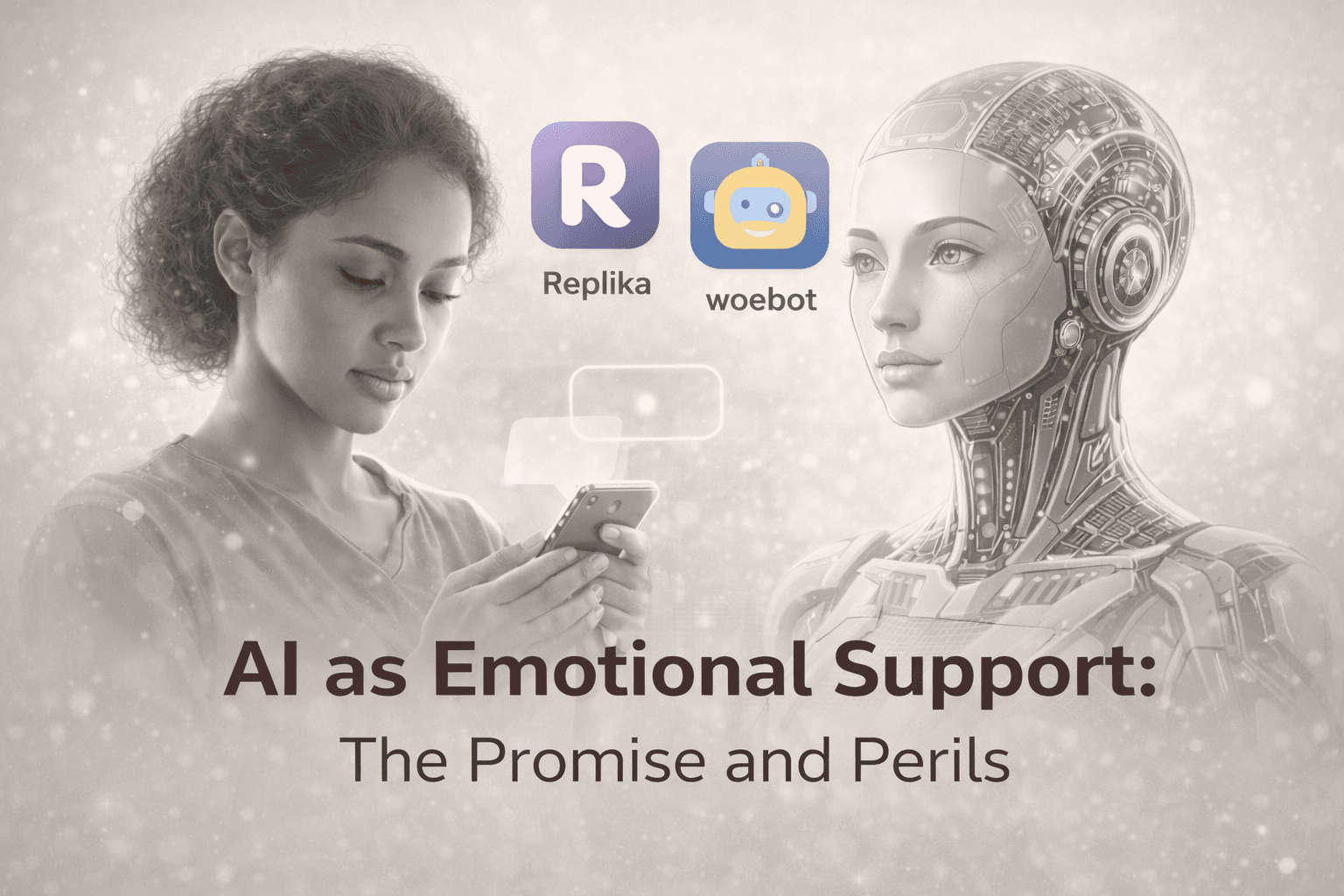

In recent years, artificial intelligence has moved beyond search engines and productivity tools. It now occupies a far more intimate space: our emotional lives.
More people are turning to AI systems for:
Late-night conversations
Mental reassurance
Relationship advice
Anxiety relief
Even companionship
Instead of texting a friend or booking a therapy session, many now open a chatbot.
This raises an important question:
What happens to humanity when emotional support becomes algorithmic?
Why People Are Turning to AI for Emotional Support
There are practical reasons.
AI is:
Always available
Non-judgmental
Anonymous
Free or low-cost
Emotionally patient
Unlike humans, AI does not get tired, irritated, or distracted. It listens endlessly. It responds immediately.
For someone feeling isolated, overwhelmed, or afraid of stigma, this can feel incredibly safe.
In a world where loneliness is increasing and access to therapy remains limited, AI offers instant emotional accessibility.
The Positive Side: What AI Gets Right
Accessibility and Affordability
Not everyone has access to professional mental health support. AI can provide basic coping strategies, breathing exercises, journaling prompts, and structured emotional reflection tools.
Reduced Stigma
Some individuals feel more comfortable opening up to a machine than to another person. There is no fear of embarrassment.
Immediate Response
In moments of anxiety or panic, waiting hours for someone to respond can feel unbearable. AI responds instantly.
Emotional Regulation Assistance
AI can guide users through:
Grounding exercises
Cognitive reframing
Mood tracking
Habit reminders
In this way, AI can function as a supplementary emotional aid.
The Hidden Costs: What AI Cannot Replace
Despite its benefits, AI lacks something fundamental:
It does not feel.
AI simulates empathy. It does not experience it.
Human emotional support is not just about words. It involves:
Shared experience
Physical presence
Tone and intuition
Mutual vulnerability
AI can mirror language patterns of care, but it cannot truly reciprocate emotional depth.
The Risks of Over-Dependence
Emotional Substitution
If individuals increasingly rely on AI instead of human relationships, social bonds may weaken.
Emotional skills develop through real interaction:
Conflict resolution
Empathy
Emotional patience
Vulnerability
Relying solely on AI may reduce opportunities to practice these skills.
Reinforcement Loops
AI systems are designed to be agreeable and supportive. But excessive affirmation without healthy challenge may reinforce harmful beliefs or distortions.
A human friend might say:
“You’re overthinking this.”
An AI may instead validate everything, because validation increases engagement.
Data Privacy Concerns
Emotional conversations are deeply personal.
When users confide:
Trauma
Relationship details
Mental health struggles
They generate sensitive psychological data.
The question becomes:
Who owns that data? How is it used?
Emotional Illusion
There is a risk that some individuals may begin to perceive AI companionship as equivalent to human connection.
This could reshape expectations of relationships. Human beings are imperfect. AI systems are optimized to respond pleasingly.
That comparison may distort relational standards.
The Near Future: Hybrid Emotional Support
In the coming years, we may see:
AI assisting licensed therapists
AI monitoring mood patterns over time
AI detecting early signs of depression
AI integrated into digital health platforms
The likely future is not replacement, but augmentation.
AI may become:
A first step before therapy
A daily emotional check-in tool
A supplement to human support networks
But it cannot become the whole system.
What Does This Mean for Humanity?
If used wisely, AI can:
Reduce loneliness
Improve emotional literacy
Offer mental health support at scale
Lower barriers to seeking help
If misused or over-relied upon, it could:
Weaken human-to-human relationships
Increase social isolation
Normalize artificial intimacy
Concentrate emotional data in corporate systems
The real risk is not that AI becomes evil.
The real risk is that humans quietly retreat from one another.
The Balance We Must Protect
Emotional connection is foundational to human civilization.
AI can assist.
AI can guide.
AI can support.
But it cannot replace:
Shared laughter
Mutual growth
Physical presence
Authentic vulnerability
The healthiest future may be one where AI acts as:
A bridge to human connection — not a substitute for it.
Real Case Studies of AI Emotional Support Platforms
Woebot
Woebot Health
Woebot is an AI chatbot designed to provide cognitive behavioral therapy (CBT)-based support. It engages users in daily check-ins and helps them reframe negative thoughts.
Key Features:
Mood tracking
CBT exercises
Conversational therapy techniques
Research Insight:
Early clinical trials suggested reductions in symptoms of anxiety and depression among users engaging regularly with the bot.
Impact:
Woebot demonstrates that structured AI can assist with mild-to-moderate mental health challenges.
Replika
Replika
Replika is marketed as an AI companion designed to build emotional bonds with users.
Users can:
Customize personality traits
Engage in deep conversations
Form emotionally intimate connections
Impact:
Many users report feeling less lonely. However, the platform has also raised concerns about emotional dependency and blurred boundaries between simulation and genuine connection.
Wysa
Wysa
Wysa combines AI chat support with optional access to human therapists.
It offers:
Anxiety management exercises
Guided meditation
Behavioral techniques
This hybrid model attempts to balance automation with professional oversight.
Final Reflection
Technology often reshapes society not through dramatic events, but through gradual normalization.
The question is not:
“Will AI replace emotional support?”
The better question is:
Can humanity maintain authentic human connection while embracing synthetic comfort?
If we remain aware, intentional, and balanced, AI can be a powerful tool.
But if convenience replaces connection, the long-term cost may not be technological — it may be deeply human.
References
World Health Organization
Mental Health and Global Access Statistics
American Psychological Association
Technology and Mental Health Trends
Woebot Health
Research & Platform Overview
Replika
Platform Information
Wysa
Clinical Research & Use Cases
Stanford University
AI and Human Interaction Research
